Sustainability
Smaller, clearer paper programs can reduce waste before the first shipment leaves.
Sustainability for notebooks and pads is not only a material question. It is also an inventory question. A disciplined Moleskine program limits unused variants, aligns formats to real work, and gives buyers a way to repeat successful assortments instead of over-ordering for uncertainty.
Planning calculator
Estimate how a tighter assortment changes the order.
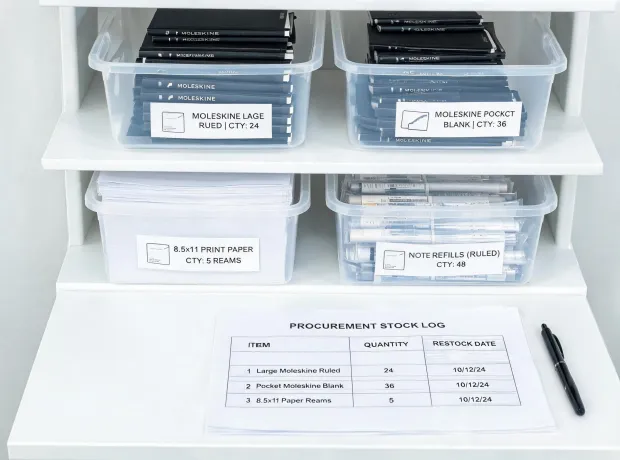
This static calculator layout helps procurement teams frame the conversation before a quote. It does not make unverifiable environmental claims; it shows where fewer variants, better pack logic, and planned replenishment can reduce surplus.
18
6
4
A sustainable paper program starts with usage discipline. If a field team needs pocket ruled notebooks, a design team needs sketchbooks, and a training team needs large ruled notebooks, the program should preserve those differences. It should remove only the variants that do not serve a defined use case. That is why we treat reduction as a planning exercise, not a blanket promise. Buyers can review material preferences, packaging requirements, and delivery timing alongside the assortment itself.
Applied cases
Three ways teams make notebook buying more responsible.
Fewer cover variants
A consulting team moved from separate event colors to a standard black cover with changing insert cards, keeping the experience premium while reducing leftover stock between programs.
Pack by actual role
An education buyer separated classroom notebooks from art studio sketchbooks instead of ordering one generic kit, improving usefulness and reducing items that students did not need.
Plan replenishment
A distributed team replaced rush orders with quarterly reviews, giving operations time to consolidate shipments and adjust quantities from real demand.
Review the footprint of your program
Use better planning to avoid unnecessary paper and notebook inventory.
Tell us how many audiences, formats, and delivery cycles are involved. We will help simplify the program without removing what users truly need.